> ## Documentation Index
> Fetch the complete documentation index at: https://docs.cosmosid.com/llms.txt
> Use this file to discover all available pages before exploring further.
# Functional Host-Agnostic Profiling
> Functional profiling via whole genome shotgun metagenomics or metatranscriptomics provides actionable insights into the molecular, biochemical, and metabolic capacity of microbial communities.
# Functional Profiling in Cosmos-Hub
Cosmos-Hub delivers an end-to-end, host-agnostic workflow for characterizing the functional potential of microbiomes across research, clinical, and environmental projects. The platform integrates state-of-the-art bioinformatics for read QC, translated gene family assignment, annotation, normalization, and interactive visualization.
### Functional Databases Available in the Cosmos-Hub
| Database | Role/What It Captures | Application Example | Functional Insight |
| :------- | :--------------------- | :---------------------- | :------------------------- |
| EC | Enzymatic reactions | Enzyme-level annotation | Mechanistic metabolic view |
| MetaCyc | Pathway networks | Pathway prediction | System-level metabolism |
| Pfam | Protein domains/motifs | Domain prediction | Structural adaptation |
| CAZy | Carbohydrate enzymes | Fiber/glycan profiling | Fiber vs mucin processing |
| GO Terms | Broad gene function | Activity trends | Broad functional overview |
## Pipeline Overview
1. **QC & Processing:** reads are cleaned and trimmed using BBDuk.
2. **Gene Family Mapping:** Reads are aligned via translated search to [UniRef90](https://www.uniprot.org/uniref), a non-redundant protein cluster database, enabling robust assignment to community-wide gene families.
3. **Functional Annotation:** Gene families are mapped to five cornerstone databases:
* [**EC (Enzyme Commission)**](https://enzyme.expasy.org/)**:** Classifies sequences by biochemical reactions.
* [**MetaCyc Pathways**](https://metacyc.org/)**:** Links genes to known metabolic networks, supporting pathway-level inference.
* [**Pfam**](https://www.ebi.ac.uk/interpro/entry/pfam/)**:** Identifies protein domains and conserved motifs.
* [**CAZy**](https://www.cazy.org/)**:** Focuses on carbohydrate-active enzymes, resolving fiber, mucin, glycan processing.
* [**GeneOntology (GO) Terms**](https://geneontology.org/)**:** Hierarchical gene ontology terms for molecular functions, biological processes, and cellular components.
4. **Normalization:** Abundances normalized as “copies per million,” facilitating cross-sample and cross-study comparisons.
5. **Visualization & Analysis:** Results rendered as heatmaps and barcharts; enables differential testing (LEfSe, MaAsLin) on functional categories, supporting biomarker discovery, R\&D, and regulatory submissions.
## Viewing the Functional Profiling Results
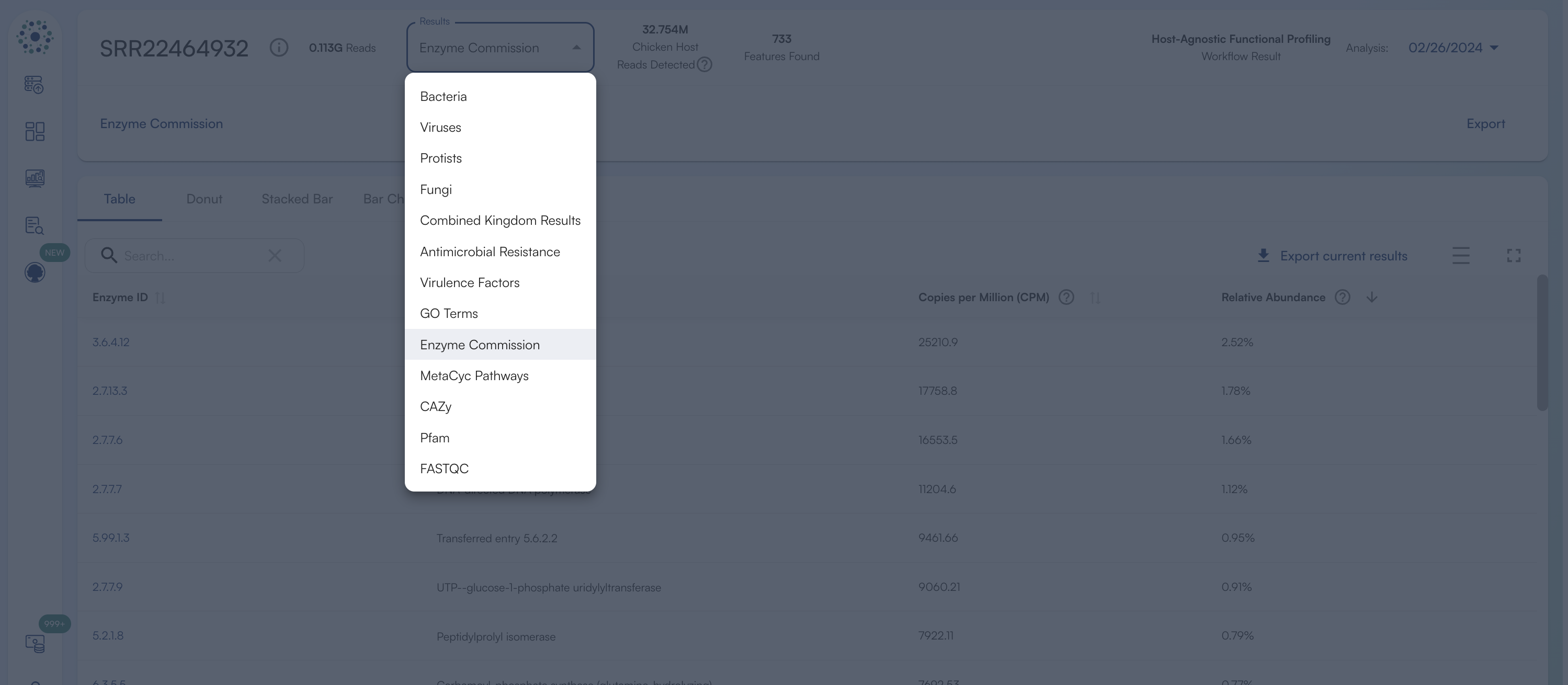
Each sample's functional analysis can be navigated using the "Results" dropdown in the Sample Menu, which includes:
* A tabular summary of database-level annotations
* Visual charts for intuitive inspection of pathway and enzymatic profiles
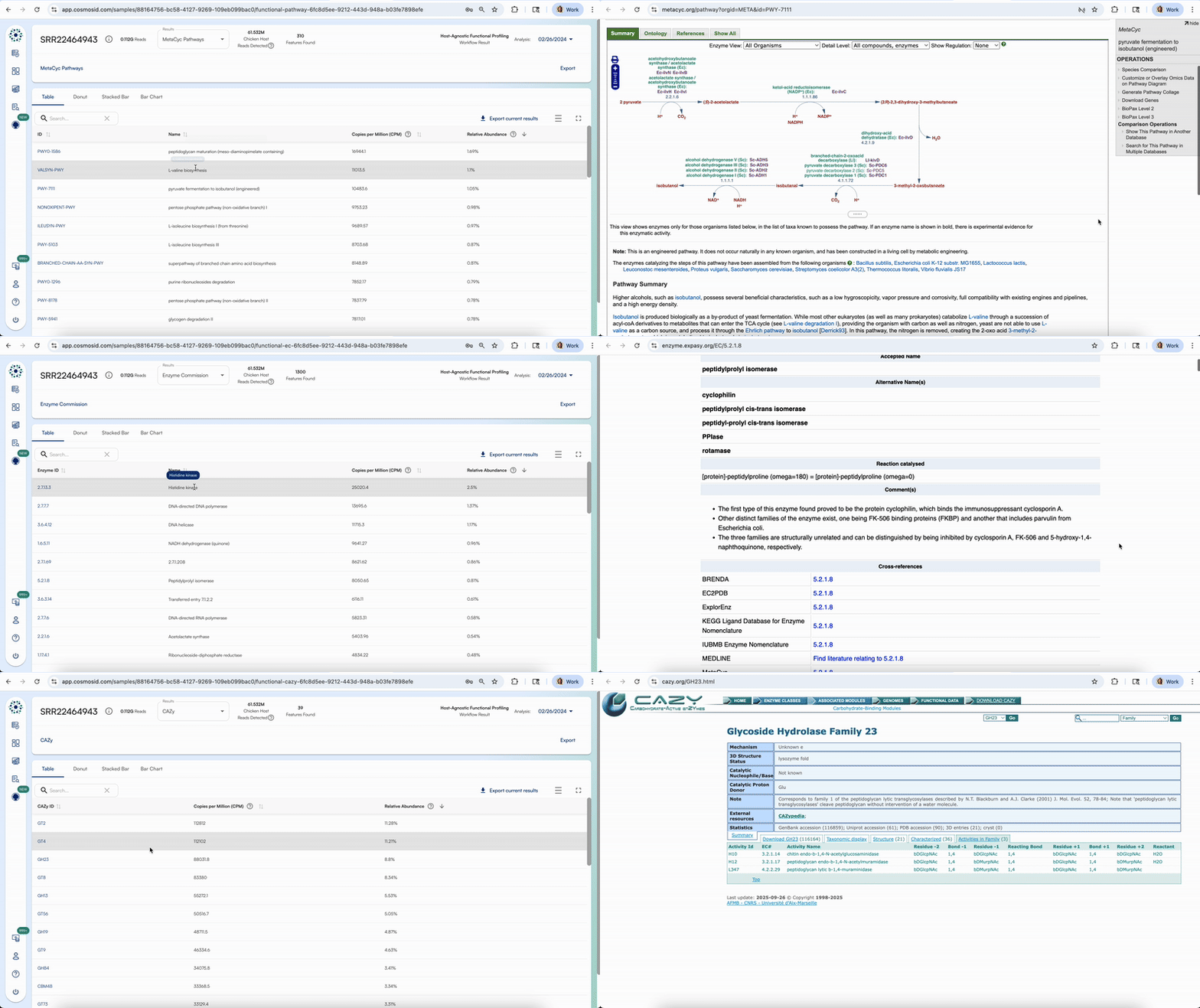
* Links for feature-level exploration on source database websites
The single sample view of functional workflow entails the tabular view of all databases along with stacked bar chart and donut chart to aid in visual inspection of functional capabilities of the microbiome population.
## Accessing the Reference Database Entries via Hyperlinks
Clicking on the first column for each respective functional databases will take you to that specific feature's description on that respective database's website.
## Technical Notes
* Reads mapped with weighting for mapping quality, coverage, and gene sequence length.
* Annotations use curated crosswalks from UniRef90 to EC, MetaCyc, Pfam, CAZy, and GO Terms.
* Abundance values normalized for sequencing depth using Total-sum scaling (TSS) (copies per million).
* Reference guides: Bushnell 2021, UniProt 2016, Franzosa et al. 2018, Caspi et al. 2007, Carbon et al. 2008.
## **Why perform functional analysis on your microbiome data?**
By integrating all these annotation types, Cosmos-Hub (and similar functional profiling frameworks) can:
* **Map the “wiring” of metabolism**: EC → MetaCyc lets you see how individual enzymatic steps may assemble into pathways.
* **Go beyond metabolism**: GO and Pfam capture regulatory, structural, transport, signaling, and other auxiliary functions.
* **Provide specialization where it’s needed**: CAZy focuses on carbohydrate metabolism, which is often key in microbiome studies (e.g. gut fiber degradation).
* **Differential functional analysis**: you can compare which functional categories are enriched or depleted across sample groups (e.g. disease vs healthy) in an interpretable manner (e.g. “glycolysis up,” “cell wall polysaccharide degradation down”).
In other words, rather than only asking “which taxa are present?”, you can ask “what can they do or are likely capable of doing?” in biochemical, ecological, or physiological terms.
## Example Use Cases of Functional Profiling for Gut Microbiome
### *Healthy vs. Disease (e.g., Inflammatory Bowel Disease)*
Cosmos-Hub identifies specific enzyme families (via EC numbers) whose abundance changes between groups.
* **Healthy gut:** Higher abundance of enzymes such as *butyrate kinase* (EC 2.7.2.7) and *acetate-CoA transferase* (EC 2.8.3.8), reflecting active **short-chain fatty acid (SCFA)** production that supports gut barrier integrity.
* **IBD gut:** Increased *nitrate reductase* (EC 1.7.99.4) and *formate dehydrogenase* (EC 1.17.1.9), suggesting a shift toward **oxidative and nitrate respiration**, consistent with inflammatory and dysbiotic states.
*EC-level insights give you mechanistic clues about which chemical reactions dominate in each condition.*
Using EC annotations, Cosmos-Hub infers pathway presence and abundance through **MetaCyc**.
* **Healthy gut:** Enrichment in pathways like *butyrate biosynthesis I (PWY-5676)*, *methanogenesis from H₂/CO₂ (METHANOGENESIS-PWY)*, and *vitamin K₂ (menaquinone) biosynthesis (PWY-5838)* — all key for maintaining energy balance and mucosal health.
* **IBD gut:** Enrichment in *lipopolysaccharide (LPS) biosynthesis* and *nitrate reduction pathways*, consistent with a pro-inflammatory metabolic signature.
*MetaCyc translates raw gene potential into interpretable, system-level metabolism.*
Pfam domain profiling highlights structural motifs that increase in disease.
* **Healthy gut:** More *ABC transporter permease* domains (PF02653) supporting nutrient import/export.
* **IBD gut:** Elevated *TonB-dependent receptor* domains (PF00593) and *heat shock protein* domains (PF00012), reflecting **stress adaptation** and **host-derived substrate utilization**.
*Pfam captures subtle domain-level adaptations beyond classical enzyme functions.*
Carbohydrate-active enzymes show clear ecological reprogramming:
* **Healthy gut:** Enrichment of *GH43* and *GH3* families involved in **dietary fiber degradation** (xylan, arabinoxylan, cellulose).
* **IBD gut:** Drop in fiber-degrading CAZymes and rise in *GH98* and *GH92* families targeting **host mucins**, suggesting a shift toward mucosal glycan foraging.
*CAZy data reveals how the microbiome’s “diet” shifts from plant polysaccharides to host glycans.*
At the ontology level, Cosmos-Hub maps genes to GO terms to show system-wide changes:
* **Healthy gut:** Enrichment in *oxidation-reduction process* and *fermentation* (biological process), *cell wall biosynthesis* (molecular function).
* **IBD gut:** Upregulation of *response to oxidative stress*, *iron ion transport*, and *biofilm formation* — markers of an inflamed microenvironment.
*GO Terms provide a top-down lens linking molecular activity to community-level biology.*
**Considerations & Limitations**
* DNA/transcript-based annotation infers functional potential, not direct activity.
* Some taxa and functions may be underrepresented in current databases.
* Pathway completeness is predicted; presence does not guarantee metabolic flux.
For custom protocols, sample-type recommendations, or application-specific database advice, contact [help@cosmos-hub.com](mailto:help@cosmos-hub.com).
## Technical Appendix
### FUNCTIONAL Workflow:
Initial QC, adapter trimming and preprocessing of metagenomic sequencing reads are done using BBduk (1). The quality controlled reads are then subjected to a translated search against a comprehensive and non-redundant protein sequence database, UniRef 90. The UniRef90 database, provided by UniProt (2), represents a clustering of all non-redundant protein sequences in UniProt, such that each sequence in a cluster aligns with 90% identity and 80% coverage of the longest sequence in the cluster. The mapping of metagenomic reads to gene sequences are weighted by mapping quality, coverage and gene sequence length to estimate community wide weighted gene family abundances as described by Franzosa et al (3). Gene families are then annotated to MetaCyc (4) reactions (Metabolic Enzymes) to reconstruct and quantify MetaCyc (4) metabolic pathways in the community as described by Franzosa et al (3). Furthermore, the UniRef\_90 gene families are also regrouped to Enzyme Commission Enzymes, Pfam protein domains, CAZy enzymes and GO Terms in order to get an exhaustive overview of gene functions in the community. Lastly, to facilitate comparisons across multiple samples with different sequencing depths, the abundance values are normalized using Total-sum scaling (TSS) normalization to produce "Copies per million" (analogous to TPMs in RNA-Seq) units.
References:
1. Bushnell, B. (2021). BBDuk Guide - DOE Joint Genome Institute. Retrieved 1 August 2021, from [https://jgi.doe.gov/data-and-tools/bbtools/bb-tools-user-guide/bbduk-guide/](https://jgi.doe.gov/data-and-tools/bbtools/bb-tools-user-guide/bbduk-guide/)
2. UniProt: the universal protein knowledgebase. (2016). Nucleic Acids Research, 45(D1), D158-D169. doi: 10.1093/nar/gkw1099
3. Franzosa, E., McIver, L., Rahnavard, G., Thompson, L., Schirmer, M., & Weingart, G. et al. (2018). Species-level functional profiling of metagenomes and metatranscriptomes. Nature Methods, 15(11), 962-968. doi: 10.1038/s41592-018-0176-y
4. Caspi, R., Foerster, H., Fulcher, C., Kaipa, P., Krummenacker, M., & Latendresse, M. et al. (2007). The MetaCyc Database of metabolic pathways and enzymes and the BioCyc collection of Pathway/Genome Databases. Nucleic Acids Research, 36(Database), D623-D631. doi: 10.1093/nar/gkm900
5. Carbon, S., Ireland, A., Mungall, C., Shu, S., Marshall, B., & Lewis, S. (2008). AmiGO: online access to ontology and annotation data. Bioinformatics, 25(2), 288-289. doi: 10.1093/bioinformatics/btn615
 ## Accessing the Reference Database Entries via Hyperlinks
Clicking on the first column for each respective functional databases will take you to that specific feature's description on that respective database's website.
## Accessing the Reference Database Entries via Hyperlinks
Clicking on the first column for each respective functional databases will take you to that specific feature's description on that respective database's website.
 ## Technical Notes
* Reads mapped with weighting for mapping quality, coverage, and gene sequence length.
* Annotations use curated crosswalks from UniRef90 to EC, MetaCyc, Pfam, CAZy, and GO Terms.
* Abundance values normalized for sequencing depth using Total-sum scaling (TSS) (copies per million).
* Reference guides: Bushnell 2021, UniProt 2016, Franzosa et al. 2018, Caspi et al. 2007, Carbon et al. 2008.
## **Why perform functional analysis on your microbiome data?**
## Technical Notes
* Reads mapped with weighting for mapping quality, coverage, and gene sequence length.
* Annotations use curated crosswalks from UniRef90 to EC, MetaCyc, Pfam, CAZy, and GO Terms.
* Abundance values normalized for sequencing depth using Total-sum scaling (TSS) (copies per million).
* Reference guides: Bushnell 2021, UniProt 2016, Franzosa et al. 2018, Caspi et al. 2007, Carbon et al. 2008.
## **Why perform functional analysis on your microbiome data?**