

1
Get Download URLs
Start by selecting your samples in the “Cohorts and Metadata” menu, and select the “Export Samples” → “Get Download URLs” to generate download links in either CSV or TSV format.
2
Open the file in a spreadsheet or text app (i.e., Excel)
Open it in a spreadsheet or text app to get the links. The URL column contains the download link for that particular sample (paired-end files will have 2 files with 2 unique URLs).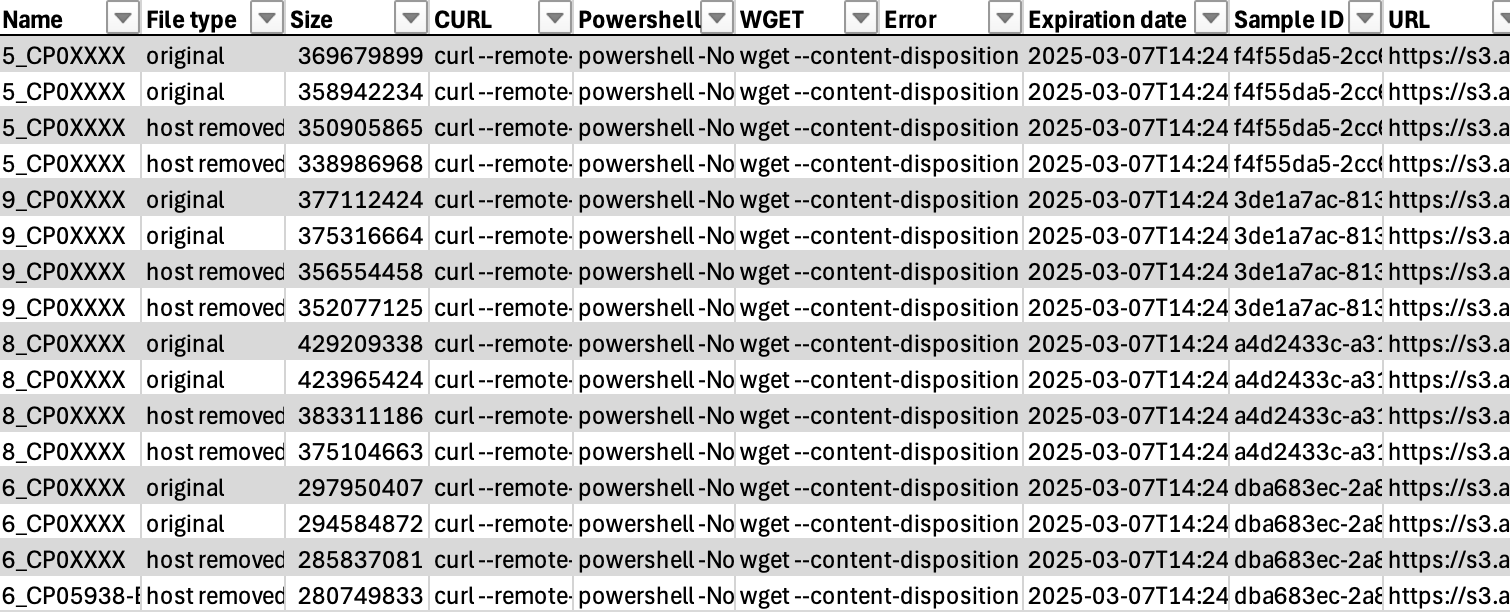
3
Use the generated URLs or preformatted commands (CURL, POWERSHELL, or WGET) to download raw fastqs
Browser Method:
Paste URLs from the “URL” column directly into your web browser to initiate the download to your default Downloads folder.Terminal Method:
Use the provided preformatted commands (CURL, POWERSHELL, or WGET) from the spreadsheet. Simply navigate to your target directory in the terminal and paste the commands.
Paste URLs from the “URL” column directly into your web browser to initiate the download to your default Downloads folder.Terminal Method:
Use the provided preformatted commands (CURL, POWERSHELL, or WGET) from the spreadsheet. Simply navigate to your target directory in the terminal and paste the commands.
How can you download raw fastqs for multiple samples all at once using UNIX terminal or PowerShell from the download URL CSV/TSV file?
The bash/PowerShell commands can be used for downloading multiple files using the download URL CSV/TSVDownloading WGET on MacOS
macOS users: wget is not installed by default on macOS. You’ll need to install it first using Homebrew:
- Install Homebrew (if not already installed):
- Install wget:
Downloading on Windows 11
Windows 11 users:
- Download the CSV file from Cosmos Hub
Download the CSV/TSV file that contains your sample download links. You can follow steps 1 and 2 here at https://docs.cosmosid.com/docs/download-your-raw-fastqs - Create a new empty folder
Create an empty folder on your computer and move the CSV/TSV file into it. - Open PowerShell in that folder
Open the folder, right click on an empty space, and select Open in Terminal. If you do not see it, click Show more options first. - Copy and paste this command into the PowerShell terminal
Note: Make sure to replace"./<csv_filename>.csv"with the exact name of your downloaded CSV/TSV file (e.g:"./samples_download_urls_2026-05-08_18_46.csv").
For CSV fileFor TSV fileNote: Opening or editing the CSV or TSV file in spreadsheet software such as Microsoft Excel may change the delimiter used to separate the columns, depending on your local settings. If this happens, you may need to update the-Delimitervalue in the PowerShell command accordingly. - Press Enter
The downloads will start automatically. Keep the PowerShell window open until all files finish downloading.
Note: depending on the number of files and their size, the download may take some time. Make sure your computer has enough available storage space before starting.