

There are 4 upload methods to choose from:
Upload from your Computer
Link a BaseSpace Account
Import from NCBI SRA
Use the Command Line Interface
Select Your Data Type
- Amplicon (16S / ITS)
- Shotgun Metagenomics
- SRA Upload
Amplicon pipelines are used to identify bacterial or fungal communities based on specific genes. These workflows support both single-end and paired-end reads.
Requirements
Requirements
- Read type: Paired-end or single-end
- Min samples: 10 (for ASV/DADA2 workflows)
- File size: ≤ 1 GB uncompressed (250 MB compressed)
- PHRED score ≥ 20
-
Formats:
.fastq.gz,.fq.gz,.fasta.gz,.sra.gz -
Paired-end naming:
SampleID_R1_001.fastq.gzSampleID_R2_001.fastq.gz
- Reads must overlap ≥ 15 bp
-
Watch the 16S Tutorial Video
Workflow Options
Workflow Options
- ASV 16S rRNA Profiling (DADA2-based)
- OTU ITS rRNA Profiling (QIIME2-based)
Common Pitfals
Common Pitfals
- Filenames with spaces or special characters will break pairing
- Unpaired files will appear as “Single-read samples”
Uploading Metadata
You can upload a metadata CSV during or after your data upload through the Cohorts and Metadata page.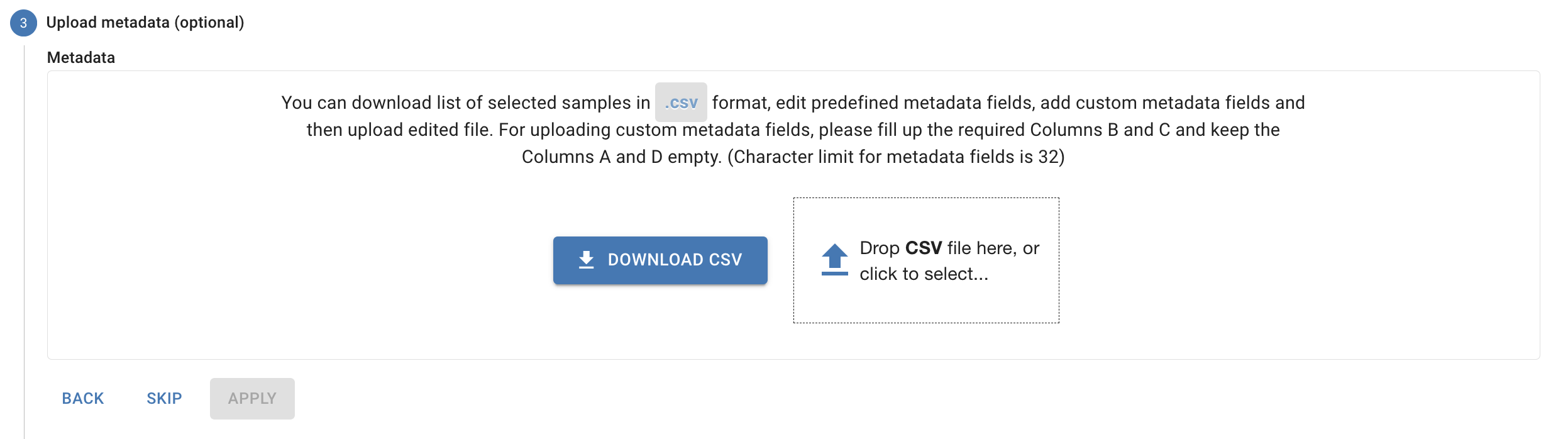
Workflow Selection
After upload, choose a workflow that matches your data type. The Cosmos-Hub will only show valid options based on your selections.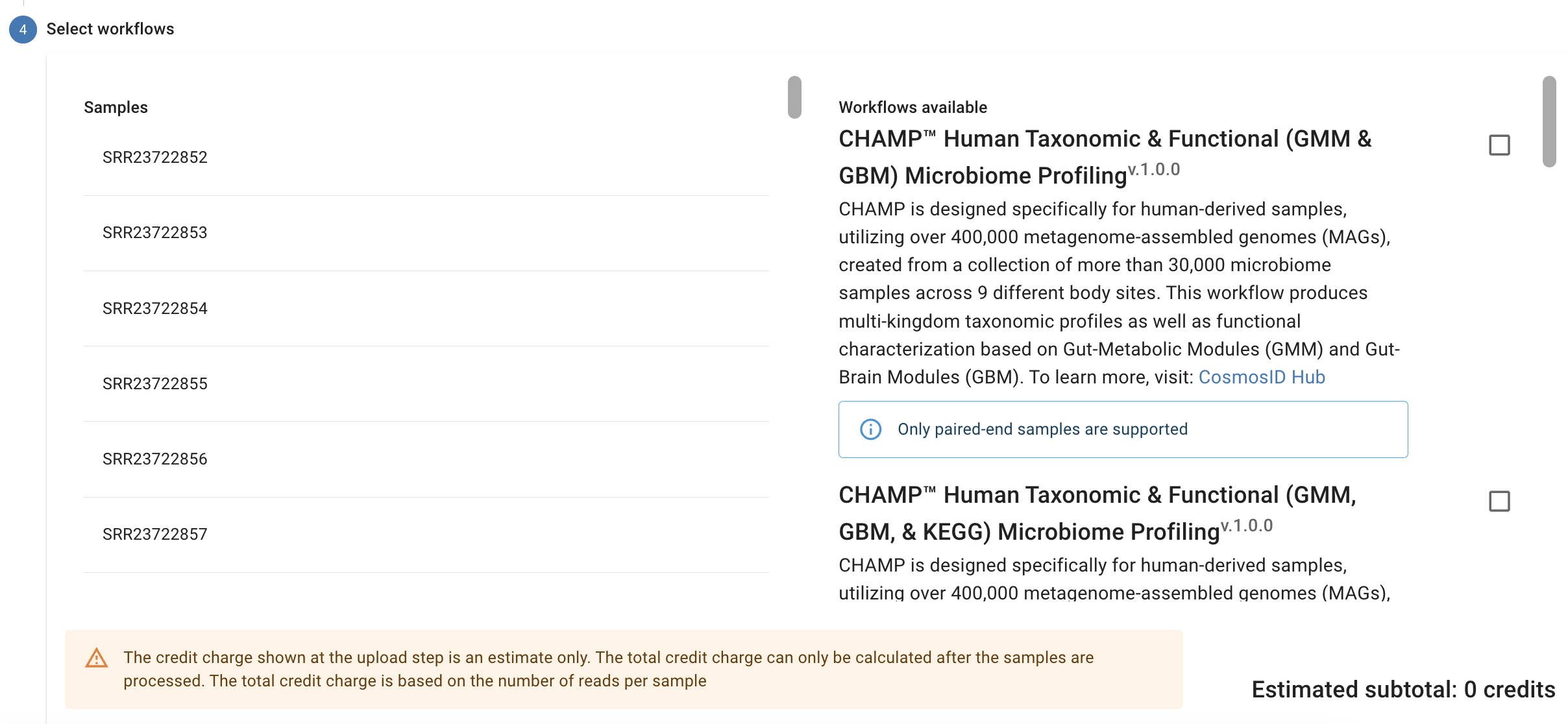
Other notes:
- If a sample fails to upload, you can retry it
- If a sample is not in the proper format or fails to run for another reason, the status will show “failed” and you will not be charged credits.
- If you have problems uploading or with a failed sample, please submit a help ticket or email us at help@cosmos-hub.com.